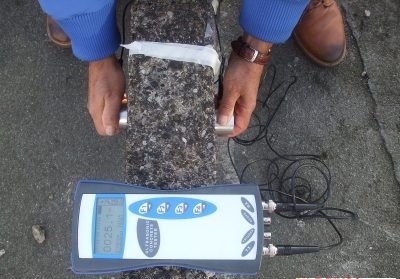
BDNDT Provide Ultrasonic Pulse Velocity (UPV) Test service in Bangladesh. We Know that Ultrasonic Pulse Velocity (UPV) test is a non-destructive method for used to determine the integrity and quality of structural concrete or stone (up to 6 feet thick) by measuring the speed and attenuation of an ultrasonic wave passing through the element being tested. UPV assessing concrete quality by measuring the speed of ultrasonic sound waves through it, with higher velocities indicating denser, better-quality concrete and slower speeds suggesting voids, cracks, or poor compaction; the test uses transducers on the concrete surface, a coupling gel, and calculates velocity (distance/time) to detect internal flaws and estimate strength. Areas with lower velocities typically have lower density and strength relative to high velocity areas. Data collected along multiple test paths can be used to create tomographic images of defects.
Ultrasonic Pulse Velocity (UPV)
Identify voiding, honeycombing, cracking and other defects
Identify areas of low-quality concrete
Define the size and shape of a defect by using multiple test paths
Two-sided access required for direct-path testing
Test around corners when complex geometry precludes direct-path testing, such as at beam intersections
Test across a surface for surface-opening crack depth measurements
UPV Principle
Pulse Generation: A transmitter sends high-frequency ultrasonic pulses (vibrations) into the concrete.
Wave Travel: The pulse travels through the concrete material, its speed affected by density and elasticity.
Detection: A receiver, placed some distance away, detects the arrival of the pulse.
Timing: The equipment measures the transit time (T) for the pulse to travel the known path length (L) between the transducers.
Calculation: Velocity (V) is calculated as V = L / T.