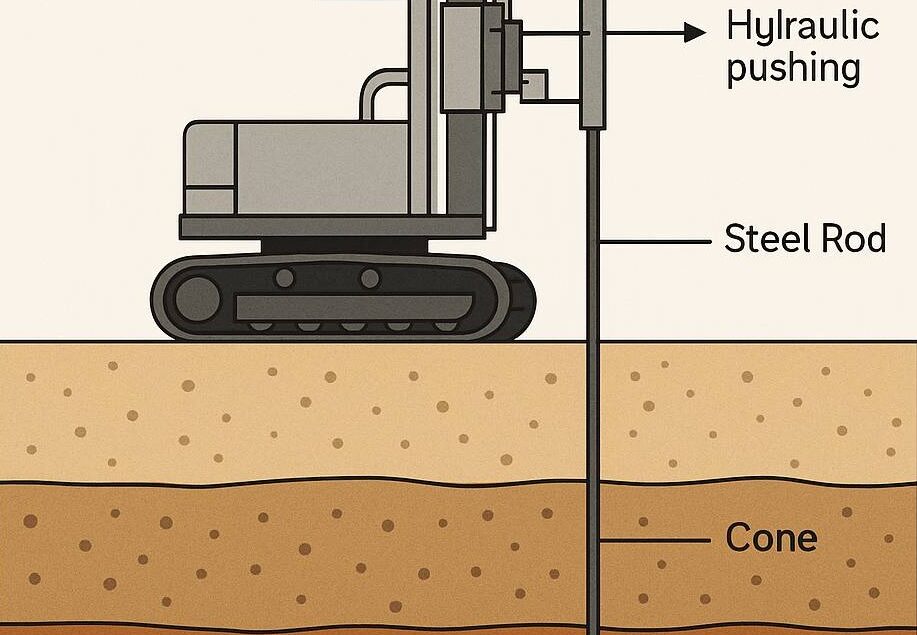
A Cone Penetration Testing (CPT) is commonly Used cylindrical instrumented cone pushed vertically into the ground at a constant rate of penetration of 2 cm/sec to identify subsurface conditions down to 40m or more, depending on the pushing equipment and soil conditions & determine the subsurface stratigraphy in in place and to estimate geotechnical parameters of the materials present. The collected data allows reliable interpretation of soil strength and stiffness parameters, and the soil type.Cone Penetration Testing uses hydraulic rams to push 36 mm diameter rods into the soil from a ballasted truck, ballasted track-truck, ballasted or anchored crawler, anchored trailer or anchored portable skids.
Advantages of CPT
There are many reasons for the widespread use of the CPT test method. Probably the most important is the In-Situ measurement… it measures soil properties in the right environment; in the soil as it is, where it is.
The real-time, on-site interpretation of logs can be used to better dial in the soil type, water table and soil parameters for engineering design – ultimately saving project cost.
Additionally, faster production rates when compared to conventional drilling and sampling result in a more cost-effective operation.