

Vacuum Box Testing
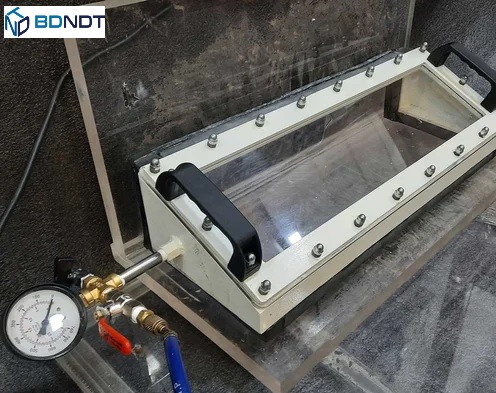
BD NDT Provide Vacuum box testing (VBT) service in Bangladesh. We know Vacuum Box Testing is a non-destructive method used to detect leaks and discontinuities in welds, tank bottoms, pipelines and pressure-retaining structures. By creating a controlled pressure difference inside a vacuum box and applying a contrast soap solution, even the smallest defects become visible as air bubbles. This technique is especially valuable in environments where safety and integrity are critical, such as maritime vessels, offshore installations and industrial storage tanks. It provides immediate, reliable visual confirmation without damaging the material. Vacuum box testing (VBT) is used in order to locate seam leaks in the welds of storage tanks. A detergent solution is commonly used in this testing method and a vacuum pump is attached to the storage tank. If a leak or fault is detected, there will appear a bubble over the leak.BDNDT can be used for Vacuum Box Testing on lap welds, shell to annular welds, butt welds, pressure vessels, piping systems, among many others. This method is great as it is capable of immediately locating any leaks. It can also detect the smallest leaks inside a given area.
Method of Works
In BD NDT provides Vacuum box testing for the detection of through-thickness leaks and is most commonly used for testing welds. Cracks, pores, and lack of fusion are typical causes of leaks detectable by this method. A bubble-forming solution is applied to the surface to be tested by flowing, spraying, or brushing and others the solution over the examination area. Household soap or detergents designed specifically for cleaning are not permitted as substitutes for bubble-forming solutions.
A commercial leak detection solution is used that is compatible with the temperature conditions during the test. As a standard technique, the temperature of the surface of the part to be examined should not be below 40°F (5°C) nor above 125°F (50°C) throughout the examination.A vacuum box with a viewing window large enough to view the complete area and to allow sufficient light to enter the box for proper examination is then placed over the surface. The box, which by means of its construction and a suitable gasket, being capable of producing and holding a pressure differential of at least 8 psi, is then evacuated. A calibrated gauge is placed in the system to verify the required pressure differential to detect vacuum seal or other types of leaks in the equipment. The area is then viewed for evidence of through-thickness leaks by the formation of bubbles on the surface.

